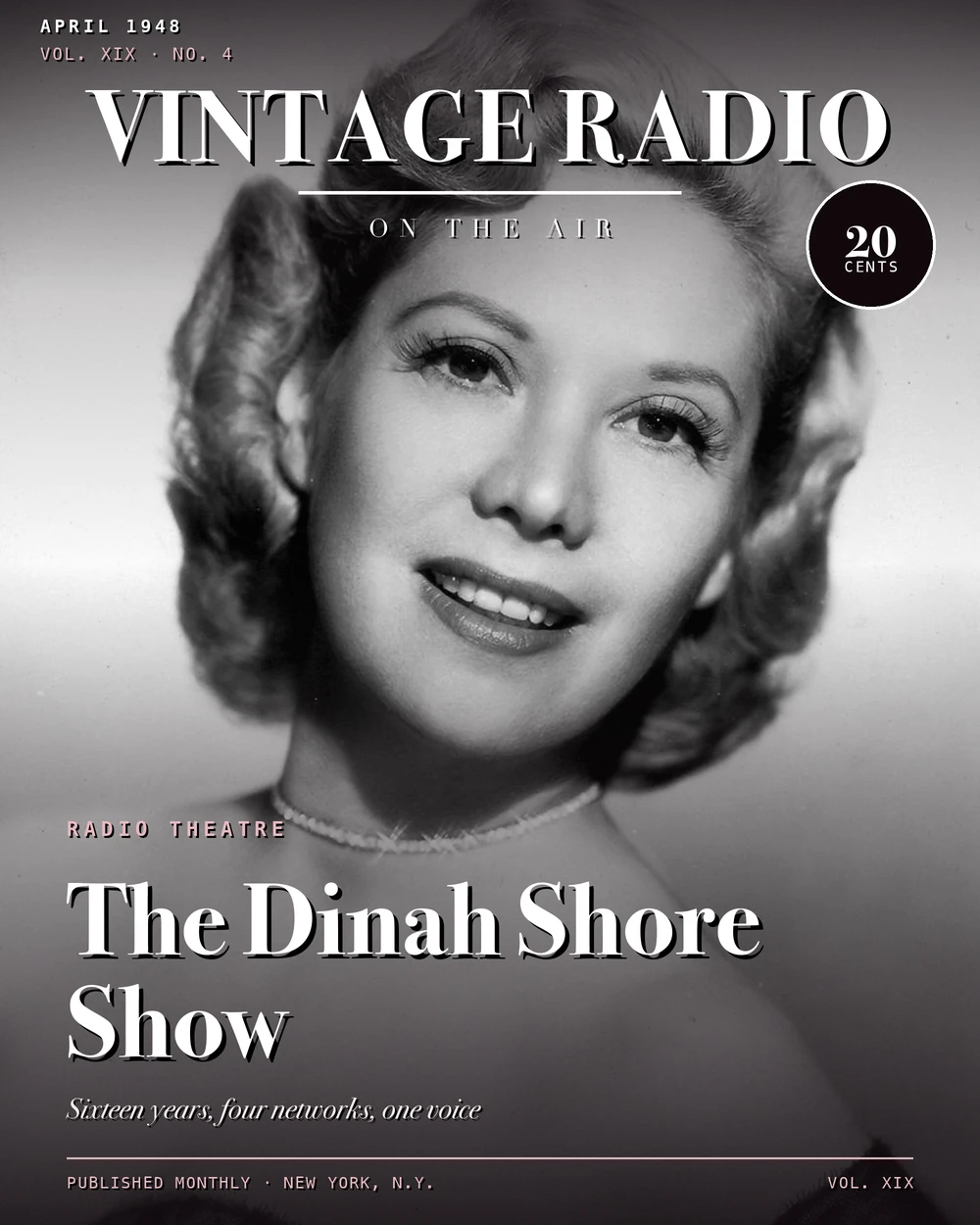
The Dinah Shore Show
How a Tennessee Singer Became a Radio Star
Dinah Shore didn't begin life with that name. She was born Frances Rose Shore on February 29, 1916, in Winchester, Tennessee, the daughter of Russian Jewish immigrants Solomon Shore and Anna Stein, who ran a dry-goods store in Nashville. As a toddler, she contracted polio, which left her with a deformed foot and a noticeable limp. Her mother worked to rehabilitate her through intensive massage and exercise, and Shore concealed the disability throughout her career. What she couldn't conceal — and never needed to — was her voice.
She started singing on Nashville's WSM while still a student at Vanderbilt University, where a local show called "Our Little Cheerleader of Song" built enough of a following to encourage her move to New York after she graduated in 1938 with a sociology degree. When disc jockey Martin Block at WNEW couldn't remember her real name, he called her "the Dinah girl" because she'd sung "Dinah" — the Ethel Waters–associated number — in her auditions. The name stuck and followed her everywhere.
In early 1939, Shore joined the Leo Reisman Orchestra for a two-week engagement, during which Xavier Cugat spotted her and brought her in as vocalist for a series of recordings. Those records, including "The Breeze and I," caught the attention of bandleader Ben Bernie, and her regular appearances on Bernie's CBS program that spring were what landed her the first of many series of her own. By August 6, 1939, she was on the Blue Network with a 15-minute Sunday program at 7:00, conducted by Paul Lavalle.
The Cantor Years and the Making of a Singing Star
The early Blue Network shows were straight songfests — a 15-minute slot, a maestro, and Shore's voice. That formula worked well enough to sustain several runs through 1940 and into 1941. But the event that turned Shore from a radio presence into a genuine national figure was Eddie Cantor hiring her as his regular singer on "Time to Smile" in the fall of 1940.
The chemistry was immediate. Cantor had purchased the rights to a Ukrainian folk song with new English lyrics by Jack Lawrence specifically for Shore to record on the Bluebird subsidiary of RCA Victor, which had signed her in 1940. The song was "Yes, My Darling Daughter," and it sold approximately 500,000 copies in a matter of weeks — described at the time as a national sensation. "Blues in the Night" followed and was equally well received, eventually becoming her first million-seller in 1942, after which RCA moved her from Bluebird up to the main Victor label. Shore herself credited Cantor with teaching her self-confidence, comedic timing, and how to connect with an audience.
Her rising stock became obvious when an option skirmish broke out in 1941: Cantor had neglected to promptly exercise his option on Shore, and Edgar Bergen moved in with an offer of $750 a week to pull her away. The dispute went to arbitration; Cantor won, but Shore received a raise regardless. By mid-1942, Radio Life magazine was calling her the most popular singing star since the rise of Kate Smith in the early 1930s.
A Run of Sponsors and Some Complicated Advertising
Shore's own series during these years cycled through several titles and sponsors, and the sponsor relationships were not always easy. The Bristol Myers series "Songs by Dinah Shore" launched in November 1941 on the Blue Network, with Paul Lavalle conducting and Harry Von Zell serving as announcer and comic foil. Cantor was even on hand to give the show its sendoff. When Shore moved to Hollywood for film work, the series relocated with her, retitled "In Person, Dinah Shore," with Gordon Jenkins taking over as maestro and actor Truman Bradley stepping in as announcer — described in the trade press as "the last word for products appealing to feminine listeners." Warner cosmeticians also remade Shore for the camera around this same time, turning the lifelong brunette into a "honey blonde," which she remained.
The advertising proved a friction point. Shore was unhappy about having to plug Sal Hepatica, a laxative, feeling the product was simply not feminine. The situation got worse when Bristol Myers worked Mum deodorant into the mix; Truman Bradley promoted it with the line that it "is your word for charm" and would "banish undaintiness." Shore stayed with Bristol Myers for almost 18 months despite her dissatisfaction, but the arrangement eventually wound down.
The next major sponsorship was a marked improvement in tone. The Birdseye Open House, which ran first on CBS from September 30, 1943, and then moved to NBC from October 1944 through May 1946, was the first network radio program sponsored by the Birdseye frozen food brand, originating from Hollywood's KNX. Robert Emmett Dolan handled musical direction across both runs. The CBS version featured comedy segments with Cornelia Otis Skinner and Roland Young, vocals from the Joseph Lilley Singers, and guest stars that included Groucho Marx, Peter Lorre, and Ozzie and Harriet Nelson. Writers Ben Brady and Glenn Wheaton and a rotation of producers — Glenhall Taylor, Walter Bunker, and Arthur Moore — kept it running. After Birdseye came Ford Motor Company, whose Ford Show on NBC in 1946–47 was produced by Billy Wilgus and written by Abe Burrows, with comedian Peter Lind Hayes as a comic foil alongside guests.
The 1948 "Call for Music" series on CBS for Philip Morris stood apart for its production design. The opening collage layered four themes: Shore humming her theme "Dinah" against Gordon Jenkins's orchestra; Harry James playing "Ciribiribin" on open trumpet; Johnny Mercer singing "Ac-cent-tchu-ate the Positive"; and Ferde Grofe's Grand Canyon Suite, which had become indelibly associated with Philip Morris through their advertising campaigns. Johnny the Philip Morris bellhop chanting "Callll for Philip Morraiss!" capped the opening. With Shore, Mercer, and James sharing the stage, the show was pointedly billed as a triple-star half-hour, performing songs requested by fans in front of a live Friday-night studio audience.
Shore and the People Around Her
Several of the professionals Shore worked with most closely were figures of considerable standing in their own right.
Harry Von Zell, her announcer on both the Bristol Myers series and the Birdseye run, was at the time one of the busiest announcers in American radio, handling as many as twenty network programs a week. He is perhaps most remembered for a 1931 live-broadcast blooper in which he referred to President Herbert Hoover as "Hoobert Heever" — which, improbably, boosted his career, as sponsors began requesting him by name. He later earned a star on the Hollywood Walk of Fame and was posthumously inducted into the National Broadcasters Hall of Fame.
Gordon Jenkins, who conducted Shore's Hollywood Blue Network series in 1942–43, was a rising arranger-composer who had become NBC's Hollywood west coast music director in 1939 and would go on to serve as music director at Decca Records beginning in 1945.
Robert Emmett Dolan, Shore's musical director through the Birdseye years and the Ford Show, was a Broadway conductor turned radio and film professional. He had directed the orchestra on the Burns and Allen program and the Sealtest show, and he became Paramount Pictures' music director in the early 1940s, conducting on sixteen Bing Crosby films. He later taught orchestration and conducting at Columbia University and wrote the textbook Music in Modern Media in 1969.
The War Years and What They Meant to Her
Shore's profile during World War II went well beyond radio. She participated in Armed Forces Radio Service Command Performance programs, and in August 1944 she toured the European Theater of Operations, widely reported as the first female celebrity to perform for troops on the front lines. Soldiers of the 4th Infantry Division, who had landed at Utah Beach on June 7, 1944, named a bridge in Normandy "The Dinah Shore Bridge" after she performed for them in France. According to the Jewish Women's Archive, among American servicemen only Frank Sinatra exceeded her wartime popularity.
Her recording career ran parallel to this and was thriving. After "I'll Walk Alone" reached number one in 1944, she moved from RCA Victor to Columbia Records in early 1946. At Columbia she scored the greatest commercial successes of her recording career: "Shoo Fly Pie and Apple Pan Dowdy," followed by "Buttons and Bows" in 1948, which sat at number one for ten weeks and was the most popular song of that year. "The Gypsy" and "The Anniversary Song" were other number-one hits from that period. Over her career she accumulated nine gold records.
Radio Winds Down, Television Opens Up
Shore returned to work with Cantor on his Pabst Beer show from October 1948 through June 1949. A final stretch of radio work followed: an Oxydol-sponsored weeknight 15-minute series on CBS from April 1950 through December 1952, billed as "The Jack Smith Show, with Dinah Shore," and then an NBC daily series from March 1953 through July 1955, sponsored by Chevrolet, that was effectively the audio feed from her television show broadcast simultaneously.
That television show, The Dinah Shore Show on NBC, had launched November 27, 1951, running Tuesday and Thursday nights at 7:30 immediately after John Cameron Swayze's Camel News Caravan. Media critic John Crosby praised it in 1951 as "a triumph of simplicity" and "the most intelligently thought out show that has yet come east from Hollywood." Billboard critic Hal Webman, in the magazine's December 8, 1951 issue, credited writer-producer-director Alan Handley for finding "just the right camera angles" and for maintaining the "steady drive, flow and pacing" of the entertainment. Shore herself had always felt film was not her medium — she appeared in eight feature films between 1943 and 1952 and found the work unsatisfying — and television's intimate scale suited her in ways the movie screen never had.
The Dinah Shore Chevy Show, which began in October 1956 on NBC in prime-time color on Sunday nights, ran through the end of the 1963 season and established her as a television institution. TV Guide eventually ranked her 16th on its list of the top fifty television stars of all time. She won nine Emmy Awards, a Peabody, and a Golden Globe, and was inducted into the Television Academy Hall of Fame in 1992. She died of ovarian cancer on February 24, 1994, in Beverly Hills, five days before what would have been her 78th birthday.